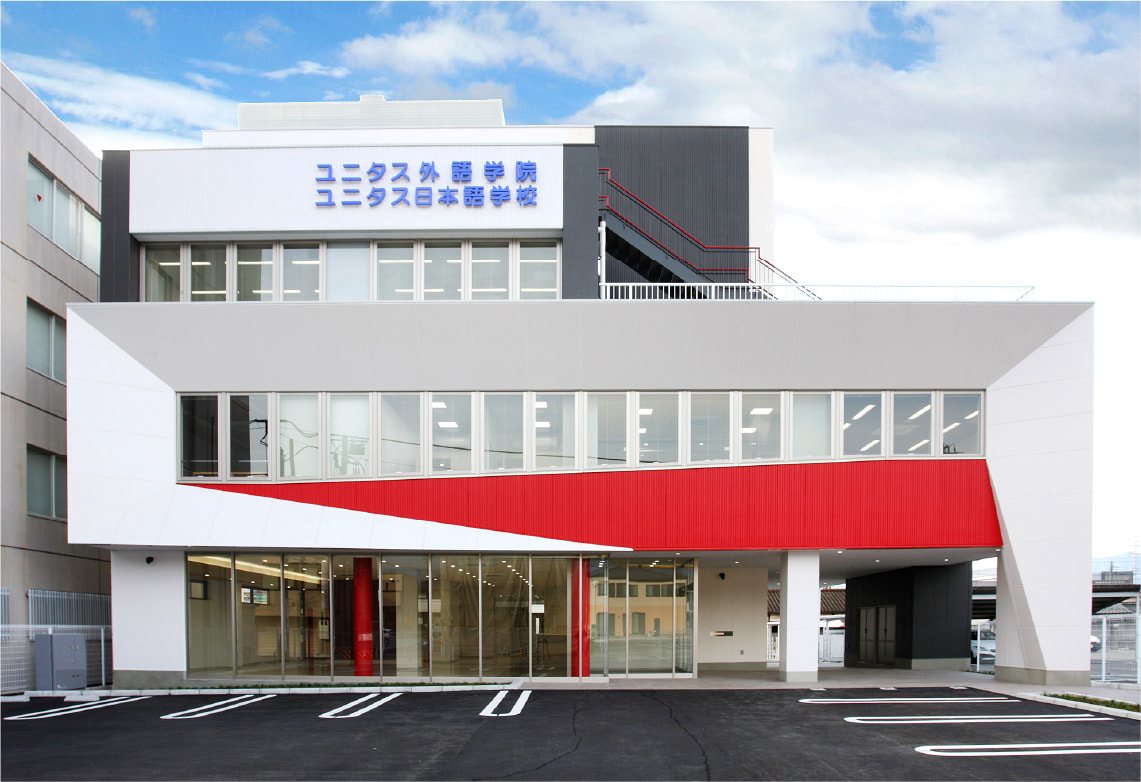
Unitas Japanese Language School
Unitas Japanese Language School
- University referrals
- 12 schools accepting applications with a recommendation letter ›
- Admission
- 4 times a year · choose your intake month ›
- AM & PM classes
- Decided by the school ›
Compare side by side with other schools →
Tuition and conditions may change depending on the intake. If you contact us, we will check with the school and give you accurate details.
Nearby schools comparedBy distance · no ads or paid placement
- Unitas Japanese Language SchoolThis schoolTuition/yr¥800,000Installments OKProgression—IntakesJan · Apr · Jul · Oct
- Yamanashi Foreign Language Institute1.5km›Tuition/yr¥835,000Progression—IntakesApr · Oct
- Minori International Academy10.7km›Tuition/yr¥930,000Progression—IntakesApr · Oct
- A.C.C. International Exchange Academy49.4km›Tuition/yr¥718,000Progression75%IntakesApr · Jul · Oct
— means SALLAE has not yet found the data.
About the school
A school that puts effort into progression to universities and vocational schools — 4 of its 5 courses are progression courses, and according to the completer report published in June 2026, 157 of the 237 completers in FY2025 progressed to universities and similar institutions in Japan. As a Teikyo University Group school, students enrolled for 6 months with 90% or more attendance and good grades can take Teikyo University's recommendation exam without the EJU. Unitas, which began as an English school in 1970 and was established in 1983, is a Japanese language school in Kofu; its building, moved in 2017, is a 7-minute walk from Kofu Station, with a capacity of 680 and students from 30 or more countries at all times. There is no school dormitory, but the website lists 77 nearby properties (¥20,000–¥59,000 per month), and there are staff who speak Chinese, Korean, Vietnamese and English.
Published data and school website
Tuition
If you saw a lower amount elsewhere, it may not include the admission fee and application fee
Median 1-year tuition in other areas — Kyoto ¥911,000(7 schools) · Kanagawa ¥880,000(8 schools) · Okinawa ¥858,000(6 schools) · Tokyo ¥840,600(56 schools) · Fukuoka ¥835,000(12 schools) · Hyogo ¥825,500(7 schools) · Osaka ¥814,000(27 schools) · Shizuoka ¥790,000(9 schools) · Chiba ¥745,333(10 schools) · Aichi ¥740,667(5 schools)
Cost details · course tables · notes · 5 items
- One-time fees
- ¥800,000Tuition ¥610,000 · Application fee ¥20,000 · Admission fee ¥60,000 · Miscellaneous expenses ¥100,000 · Insurance ¥10,000
According to the school guide, fees are paid in one lump sum at enrollment. Installments are available.
Tuition and other fees (yen, tax included)
1 year in one payment: ¥800,000. Half-yearly payment: ¥465,000 at enrollment and ¥375,000 for the next half year (first-year total ¥840,000). Half-yearly payment is not available for some nationalities.
The amount for year 2 has not been published.
After arriving in Japan, you must separately enroll in National Health Insurance.
1 month ¥75,000 · 2 months ¥140,000 · 3 months ¥205,000 (Kofu campus; the ¥10,000 application fee applies only when an invitation letter is prepared)
Short-term 3 months is a separate ¥205,000 (admission fee ¥10,000 · tuition ¥165,000 · miscellaneous fees ¥30,000).
School website · 2025-03-14 updated
Whether it is refundable
- (1) Before obtaining a visa
- The application fee is not refunded.
- (2) Visa not issued or enrollment declined
- Tuition, miscellaneous fees and school insurance are 100% refunded. The application fee and admission fee are not refunded.
- After enrollment (paying every 6 months), if enrolled for less than half a year
- Not refunded
- After enrollment (paying 1 year), if enrolled for less than half a year
- Tuition of ¥285,000 and miscellaneous fees of ¥50,000 are refunded (Kofu campus). The application fee, admission fee and school insurance are not refunded.
See refund policy in detail · 3 more lines
- After enrollment (paying 1 year), if enrolled for half a year or more
- Not refunded
- Refunds of course fees for year 2 and after
- The refund rules in 3, 4 and 5 above apply.
- When you want to withdraw
- Submit a written withdrawal notice by the month before the planned withdrawal month. Oral requests are not accepted. The remittance fee for the refund is borne by the student.
Admission & dates
- Apr intake
- 2-year course · Application April admission: application deadline late October of the previous year, results announced late February.
- Jul intake
- 1 year 9 months course · Application July admission: application deadline mid-February, results announced mid-May.
- Oct intake
- 1 year 6 months course · Application October admission: application deadline early May, results announced mid-August.
- Jan intake
- 1 year 3 months course · Application January admission: application deadline mid-August of the previous year, results announced early November.
- Japanese level
- No Japanese level required
Depending on nationality and educational background, proof of at least 150 hours of prior study is required. 150–200 hours of study is recommended, and you must learn hiragana and katakana.
Deadline and capacity rules
Those who completed 12 or more years of school education (high school graduates or expected graduates or higher). Aged 18 or older at enrollment (inquire about exceptions).
School website · 2025-03-14 updated
Classes
- Morning
- 09:00-12:30 Morning class: 9:00–12:30 (intermediate and advanced students)
- Afternoon
- 13:00-16:30 Beginner
- AM/PM placement
- Classes are decided by the school based on the level check test results. Students cannot choose their class.
- Class size
- Max 20 students
- Class assignment
- Level-based 5 stages
- Elective classes
- EJU prep · JLPT prep · Progression class (university and graduate school) · Japanese culture experience · From Intermediate II and above: EJU and JLPT preparation, and trial lessons in tea ceremony, koto, chigiri-e, flower arrangement and calligraphy. Foreign languages can also be studied at the foreign language institute (Kofu campus only).
Materials · Subjects · Timetable · Details
- Materials
- Elementary: Minna no Nihongo Elementary I/II; Intermediate I: Minna no Nihongo Intermediate I; Intermediate II: Intermediate Japanese Quartet II; Advanced: Selected Reading Themes 10, and others.
- Subject
- Hiragana and katakana · Grammar · Kanji · Listening · Conversation · Reading · Writing · JLPT grammar and vocabulary · N3, N2 and N1 grammar and vocabulary, plus elective classes. Extracurricular EJU preparation also covers subjects other than Japanese.
Both progression and general courses teach comprehensive Japanese covering the four skills. Homeroom teacher system. Direct method, teaching in Japanese. Up to 20 students per class, 10–15 on average.
What each level covers · 4 stages
- Beginner I and II
- 6 monthsStudents learn important basic grammar, understand set phrases and sentences with basic kanji, and aim to hold short conversations.
- Intermediate I
- 6 monthsAims to read texts on everyday topics, understand somewhat advanced expressions and main points, and converse at a near-natural speed. JLPT N3.
- Intermediate II
- 6 monthsAims to understand the flow and intent of texts on a wide range of topics and to converse at a near-natural speed. JLPT N2.
- Advanced
- 6 monthsAims to understand the structure, content and intent of logical, somewhat complex or highly abstract texts, and to converse at natural speed. JLPT N1
School website · 2025-03-14 updated
Documents to prepare — student visa course
- Admission application formPrescribed form 1
- RésuméPrescribed form 2
- Diploma or graduation certificate from your last school (original)
- Academic transcript from the highest level of education
- Copy of passport. All pages with identity details and entry and exit records are required.
- 4 ID photos4 cm tall × 3 cm wide
Financial supporter's documents · only if applicable · 3 application requirements
Submitted by the person paying the tuition (financial sponsor)
- Financial sponsorship statementPrescribed form 3
- Documents proving the relationship with the applicant, such as a notarized proof of kinship, family register extract or birth certificate
- Certificate of employment: for company employees, the original issued by the employer; for the self-employed, a copy of the business license or similar
- Income certificate for the most recent year; for those living in Japan, an income and tax assessment certificate
- Bank balance certificate: the original, in the financial sponsor's name
- Documents proving how assets were accumulated (applicable applicants only): bank transaction statements for the most recent year, or other documents proving how assets were accumulated
- Residence certificate (juminhyo) for all family members (applicable applicants only). If you have relatives in Japan, it must list everyone in the household.
Only if applicable
- Certificate of enrolment or certificate of employment (Submit only if you are enrolled in school or employed at the time of application.)
- Original academic transcript from the school you currently attend (If you are currently enrolled)
- Copy of JLPT, J.TEST, NAT-TEST or similar results. If you have not taken a test, a certificate showing at least 150 hours of Japanese study. (Applicable applicants only)
Application requirements
All documents are valid only if prepared within 3 months before the date of application to the Tokyo Regional Immigration Services Bureau. Prepare documents in the local language and attach a Japanese translation. Parents, siblings and grandparents are typical.
Required documents differ by country. SALLAE is confirming this with the school.
For short-term courses, submit Application form (prescribed form 4). Use the school's prescribed form, leave no blanks, and have the applicant sign it. · Copy of the diploma from your last school (applicable applicants only) · Copy of passport. All pages with identity details and entry and exit records are required. · 1 ID photo (4 cm tall × 3 cm wide), taken within 3 months before applying: front-facing, upper body, no hat, plain background only.
School website · 2025-12-15 updated
Admission process
- Request an admission consultation — For enrollment procedures, please consult us first.
- Inquiry (any time) and online interview (any time) — An online interview checks the purpose of studying Japanese, study history, education and ability to pay; scores on an interview sheet determine whether students meet the standard for admission.
- Application and selection exam — Apply through an agent or directly to the school. If you pass the school's designated exam and interview, submit documents within the deadline.
- Check and correct submitted documents — Submitted documents are checked and corrected. The school reviews the submitted application documents.
- Application for status of residence (the school applies on your behalf) — If you pass the document screening, the school applies to the Tokyo Regional Immigration Services Bureau for your status of residence.
- Screening results announced; tuition payment — If approved, a Certificate of Eligibility is issued, and the school mails the original after confirming receipt of tuition and other fees. Payment is by international bank transfer or Flywire.
- Apply for a student visa / receive the student visa — When the Certificate of Eligibility arrives, apply for the visa at the Japanese consulate in your country
- Enter Japan and enrol — Entering Japan more than 1 week before the enrolment date affects your next visa renewal, so we recommend entering 1 week before the enrolment date.
- Placement test
- New students take a placement test and an interview test, and classes are organized to match each student's Japanese ability.
School website · 2025-03-14 updated
Short-term study
- Visa
- Temporary visitor(not a student visa)
- Duration
- 4 weeks – 3 months
- Open now?
- Rolling admissions, so availability varies from time to time — SALLAE will confirm with the school
Course without a student visa
- Course for residents of Japan — For residents of Japan who already hold a visa. No limit on study period; enrolment every month (April, July, October and January for beginners); application deadline is 1 month before the course starts. Includes an in-person interview and level check.
- Private lessons and semi-private lessons — One-on-one or one-on-two. Mon–Sat (Saturdays 9:00–16:00; classes after 17:00 are available), elementary to advanced, 1 month to 2 years (rolling admission). Hours, materials and content on request.
- Saturday classes — Every Saturday 11:00–12:30 (90 minutes each). Introductory I and II run 11 sessions each, practicing listening to and speaking Japanese for daily situations.
- Japanese lessons for foreign employees — Original lessons tailored to the company's and learners' needs: workplace communication, business manners, presentation training, JLPT preparation, everyday conversation and more.
- Kofu City Japanese classes — Since 2020, the school has run free Japanese classes for foreign residents under contract with Kofu City. In 2026, from June to November, there are classes for parenting, children, work, N3 and high school entrance.
★Short-term courses are not listed in the published data — it counts only student-visa courses.
School website · 2025-03-14 updated
Graduate outcomes
| FY2025 | Admitted |
|---|---|
| Employment | 44 students |
| Graduates | 237 students |
Report prepared June 30, 2026: completers 237, meeting the standard 211 (89.0%); progression to university, etc.: progression course 146 · general 11. · Persons permitted a change of status of residence (Appended Table I, Part 1, etc.): progression course 21, general course 23. · School website · Updated 2026-06-30
Reviews
If you study here or used to, tell others what the classes, teachers and daily life were like. It helps anyone deciding on this school.
Write the first reviewUniversity prep
- Teikyo University recommended admission — As a Teikyo University Group school, students can enter by recommendation. Requirements: at least 6 months enrolled at Unitas, average attendance of 90% or more, and excellent grades.
- Career guidance department — A career guidance department made up of academic and administrative staff holds progression and job information sessions, regular individual interviews and individual guidance as needed.
- EJU and JLPT prep — Exam preparation classes chosen by those who wish, and extracurricular EJU preparation classes. EJU preparation runs April to November; JLPT preparation runs all year.
- Graduate school progression guidance — Explains the application steps, including how to choose a research theme and how to write a research plan.
- Career support — There is no job-focused course, but for those who wish, the school offers job seminar information and individual job guidance outside class.
- 13 designated-school recommendations — Teikyo University · Teikyo Heisei University · Toyo University · Wako University · Shumei University · Institute of Technologists · Musashino University · Yamanashi Gakuin University · Yamanashi Eiwa College · Bunka Gakuen University · Ryutsu Keizai University · Minobusan University · Beijing Language and Culture University · Teikyo University recommendation admission. There is a list of "other designated schools that accept recommendations." More than 20 vocational schools are designated recommendation schools.
Schedule to admission
- Progression information session
- Apr · Explains the basics of going on to Japanese universities, graduate schools and vocational schools.
- EJU application briefing, graduate school admission briefing
- May · For those planning to take the EJU, an explanation of the outline, how to apply and points to note. · An explanation of the application steps, including how to choose a research theme and how to write a research plan.
- EJU 1st sitting
- Jun · 1st EJU
- In-school recruitment for those wishing to apply through Teikyo University recommendation entrance exams, and individual career interviews for all students
- Jul · 1st JLPT · In-school recruitment for Teikyo University recommendation exam applicants · Individual career interviews for all students · Explanation of the Teikyo University and other designated-school recommendation exams.
- Course on writing the application form and statement of purpose, and interview course
- Aug · Lecture on writing application forms and statements of purpose · Interview lecture. Explains the flow of the interview and points to note. · In-school selection for the Teikyo University recommendation exam. A written exam and interview are given to those who wish to enter by recommendation.
- EJU registration
- Oct · EJU application briefing
- EJU 2nd sitting
- Nov · 2nd EJU
- JLPT 2nd sitting
- Dec · 2nd JLPT
- Individual career interviews for all students
- Jan · Individual career interviews for all students
School website · 2026-04-21 updated
Daily-life support
- Pre-arrival guidance — Before students enter Japan, the school keeps in touch with the referring agency and the student and provides information on entry and enrollment as needed.
- Orientation — The new student orientation at enrollment is held in each language, and the current student orientation each term is held in Japanese.
- Multilingual staff — Hires staff who speak Chinese, Korean, Vietnamese and English,
- Accompaniment for accidents and illness — and in case of accidents or illness, school staff accompany students and act as interpreters and intermediaries.
- Apartment introductions — The school works with nearby real-estate companies to introduce affordable apartments. An apartment support team contacts the real-estate company when problems arise and helps until they are resolved.
- Part-time work — The school supports students in finding part-time work.
- Contact with guardians and study-abroad agents — When problems arise in life in Japan, the school contacts and coordinates with guardians and also contacts the referring agency.
- Accident insurance — Students with a student visa enroll in the school-designated accident insurance. Each student must also separately enroll in National Health Insurance.
- Support for graduates — The school handles requests from graduates, such as issuing certificates and consultations about visa changes after graduation.
School website · 2025-08-05 updated
Scholarship
- MEXT learning incentive for international students
- Monthly ¥30,000 × 1 yearEnrolled 1 year or more, attendance 90% or more, excellent grades. 4 recipients per year.
- Kyoritsu Maintenance Scholarship Fund scholarship
- Monthly ¥60,000 × 1 yearEnrolled for at least 1 year, attendance rate of 90% or more, excellent grades. 1 recipient per year.
- LSH Asia Scholarship (specified nonprofit organization)
- ¥100,000 Once One time only. Enrolled 1 year or more, attendance 90% or more, excellent grades. 1 recipient per year.
- Unitas Scholarship
- ¥50,000 Once One time only. Enrolled 6 months or more, attendance 90% or more, excellent grades. 20 recipients per year.
School website · 2026-04-21 updated
School life
For 1 year
- 1
- January 6, 2026: The entrance ceremony for the January intake was held. · January 23, 2026: A winter party was held.
- 3
- Graduation ceremony
- 4
- April 3, 2026: The entrance ceremony for the April intake was held. · New-student welcome event: a hike was held.
- 7
- Jul intake entrance ceremony
- 8
- Speech contest held on August 28, 2026
- 10
- Oct intake entrance ceremony
This table is based on events listed in school notices (2023–2026), so it may not be the same every year · Japanese culture experiences (tea ceremony, koto, calligraphy, etc.) are held in Intermediate II and higher classes.
- New student welcome event: a hike was held.
- A winter party was held at a luxury resort hotel right in front of Mt. Fuji (January 23, 2026).
- The 31st speech contest was held at YCC Yamanashi Prefectural Cultural Hall on August 28, 2026, with 14 intermediate to advanced students taking part.
- Opportunities to interact with local high school students (Kofu campus only)
- Japanese chat time and English chat time are held 5 times a week.
- When the local government or neighborhood associations request volunteers for district festivals or events, the school announces it on the students' social media and encourages participation.
On campus
- 3rd floor
- Terrace — You can see the Kofu mountains and the Southern Alps in one view.
- 2nd floor
- Library — There are many famous manga that you can borrow and read at home.
- Building 3 (Unicafe)
- UniCafe — A study space you can use freely, where events are held to meet Japanese and other international students.
- On campus
- Wi-Fi
2025–2026 academic calendar · Older data
- Saturdays, Sundays and public holidays
- Every week and public holidays · Monday to Friday (except public holidays and school-designated breaks)
- Winter break
- 2025-12-27 ~ 2026-01-04
- Summer break
- 2024-08-10 ~ 2024-08-18 · 2024.08.09
- Golden Week closure
- 2023-05-03 ~ 2023-05-07 · 2023.05.02
School website · 2026-09-04 updated
Access
- Transit
- JR Chuo Main Line, Kofu Station, 7 min walk
- Nearby
- 1-20-22 Takara, Kofu, Yamanashi. 7 minutes on foot from Kofu Station (website). The brochure says get off at Kofu Station and walk about 10 minutes.
- Dormitory
- None · SALLAE helps you look for housing nearby · Per the school website
School website · 2025-03-14 updated
Dorm — The school has no dormitory; it introduces share houses, apartments, homestays and similar options to those who wish.
School website · 2026-09-08 updated
SALLAE has organized the school website and published data in English.
The update date is the day that material was last revised.
Photos are materials published by the school.
This information is compiled from official sources and is not updated daily. Please confirm with the official contact before signing or applying.