Unitas Japanese Language School Tokyo Campus
Unitas Japanese Language School Tokyo Campus
- University referrals
- 12 schools accepting applications with a recommendation letter ›
- Admission
- 4 times a year · choose your intake month ›
- AM & PM classes
- Decided by the school ›
Compare side by side with other schools →
Tuition and conditions may change depending on the intake. If you contact us, we will check with the school and give you accurate details.
Nearby schools comparedBy distance · no ads or paid placement
- Unitas Japanese Language School Tokyo CampusThis schoolTuition/yr¥860,000Installments OKProgression—IntakesJan · Apr · Jul · Oct
- Yu Language Academy0.2km›Tuition/yr¥870,000Progression—IntakesJan · Apr · Jul · Oct
- Higashi-Shinjuku Japanese Language Institute0.3km›Tuition/yr¥914,000Progression—IntakesJan · Apr · Jul · Oct
- Kai Japanese School0.5km›Tuition/yr¥1,195,000Progression15%IntakesJan · Apr · Jul · Oct
— means SALLAE has not yet found the data.
About the school
This school focuses on progression to universities and vocational schools. Four of its five courses are university-preparatory, and according to the completer report published in June 2026, 202 of the 300 FY2025 graduates went on to Japanese universities and similar institutions. As a Teikyo University Group school, students enrolled 6 months with an attendance rate of 90% or higher and good grades can take the Teikyo University recommendation exam without the EJU. UNITAS began as a small school in Kofu, and this branch opened in Okubo, Shinjuku-ku in 2007 (5 minutes on foot from Higashi-Shinjuku Station). Capacity is 840, and of the 576 students enrolled in 2025, 256 are from China, the largest group. There is no school dormitory, but the school introduces share houses and apartments, and has staff who speak Chinese, Korean, Vietnamese and English.
Published data and school website
Tuition
⚠ Tuition differs by source. Please confirm with the school. School website: Tokyo campus 1 year, tuition ¥670,000 (other fees ¥100,000 and insurance ¥10,000 are separate). The website table and application guidelines say the same · Public materials of the Association for the Promotion of Japanese Language Education: 2-year course tuition ¥1,280,000, total ¥1,560,000. 1 year 3 months ¥992,500; 1 year 6 months ¥1,185,500; 1 year 9 months ¥1,372,500 Website and application guidelines: Tokyo campus 1-year tuition ¥670,000 (application fee ¥20,000, admission fee ¥60,000 and other fees ¥100,000 are the same). Association school table (Aug 2025): 2-year course tuition ¥1,280,000
If you saw a lower amount elsewhere, it may not include the admission fee and application fee
Median 1-year tuition in other areas — Kyoto ¥911,000(7 schools) · Kanagawa ¥880,000(8 schools) · Okinawa ¥858,000(6 schools) · Tokyo ¥840,600(56 schools) · Fukuoka ¥835,000(12 schools) · Hyogo ¥825,500(7 schools) · Osaka ¥814,000(27 schools) · Shizuoka ¥790,000(9 schools) · Chiba ¥745,333(10 schools) · Aichi ¥740,667(5 schools)
Cost details · course tables · notes · 5 items
- One-time fees
- ¥860,000Tuition ¥670,000 · Application fee ¥20,000 · Admission fee ¥60,000 · Miscellaneous expenses ¥100,000 · Insurance ¥10,000
According to the school guide, fees are paid in one lump sum at enrollment. Installments are available.
Tuition and other fees (yen) (tax included)
Tokyo campus: ¥495,000 for the first half-year and ¥405,000 for the second. Depending on nationality, paying tuition by half-year may not be possible.
Other fees include materials, extracurricular activity fees and a facility fee.
Students on a student visa must join the school-designated accident insurance and, separately, enroll in National Health Insurance on their own.
Short-term course, Tokyo campus: 1 month ¥80,000, 2 months ¥150,000, 3 months ¥220,000. The ¥10,000 application fee is required only when an invitation letter is prepared.
Short-term 3 months is ¥220,000 separately (admission fee ¥10,000 · tuition ¥180,000 · other fees ¥30,000).
School website · 2025-03-14 updated
Whether it is refundable
- (1) Before obtaining a visa
- The application fee is not refunded.
- (2) Visa not issued or enrollment declined
- The application fee and admission fee are non-refundable. Tuition, other fees and school insurance are refunded 100%. The bank transfer fee for the refund is borne by the student.
- ③ After enrollment (paid by half-year): if enrolled less than half a year
- Not refunded
- ④ After enrollment (paid for 1 year): if enrolled less than half a year
- Tokyo campus: tuition of ¥315,000 and other fees of ¥50,000 are refunded. The bank transfer fee for the refund is borne by the student.
See refund policy in detail · 2 more lines
- ⑤ After enrollment (paid for 1 year): if enrolled half a year or more
- Not refunded
- When withdrawing
- Submit a written withdrawal notice by the month before the planned withdrawal month. Verbal withdrawal requests are not accepted. The refund rules ③④⑤ also apply from the second year onward.
Admission & dates
- Apr intake
- 2-year course · Application April admission: application deadline late October, results announced late February
- Jul intake
- 1 year 9 months course · Application July admission: application deadline mid-February, results announced mid-May
- Oct intake
- 1 year 6 months course · Application October admission: application deadline early May, results announced mid-August
- Jan intake
- 1 year 3 months course · Application January admission: application deadline mid-August, results announced early November
- Japanese level
- No Japanese level required
Depending on nationality and educational background, proof of at least 150 hours of prior study is required. 150–200 hours of study is recommended, and you must learn hiragana and katakana.
Deadline and capacity rules
Completion of 12 or more years of school education (high school graduation or expected graduation, or above). Age 18 or older at enrollment (ask about exceptions). Courses cannot be changed after applying for a status of residence. Applications close once capacity is reached, even before the application deadline.
School website · 2025-03-14 updated
Classes
- Morning
- 09:00-12:30 Morning class: 9:00–12:30 (intermediate and advanced students)
- Afternoon
- 13:00-16:30 Beginner
- AM/PM placement
- Classes are decided by the school based on the level check test results. Students cannot choose their class.
- Class size
- Max 20 students
- Class assignment
- Level-based 5 stages
- Elective classes
- Progression class (university and graduate school) · EJU and JLPT prep · From Intermediate I, of 4 periods a day, 2 are basic Japanese classes and 2 are electives. Exam preparation is done in the electives, and depending on the period, extra EJU classes are held outside regular class hours.
Materials · Subjects · Timetable · Details
- Materials
- Beginner: "Marugoto Introductory Beginner 1/2"; Intermediate I: "Minna no Nihongo Intermediate I"; Intermediate II: "Chukyu Nihongo Quartet II"; Advanced: "Genselect Reading Themes 10" and "Manabou Nihongo Upper-Intermediate/Advanced".
- Subject
- Hiragana and katakana · Grammar · Kanji · Listening · Conversation · Reading · Composition · N3 grammar and vocabulary · Beginner covers hiragana, katakana, beginner grammar and more. From Intermediate I, N3, N2 and N1 grammar and vocabulary are added, along with elective classes.
Homeroom-teacher system: the homeroom teacher guides and advises students on both classes and daily life. Direct method, teaching Japanese in Japanese. Up to 20 students per class, 10–15 on average.
What each level covers · 4 stages
- Beginner I and II
- 6 monthsBeginner I and II (3 months each). Students learn Japanese they can use in real situations through actual communication with others. JLPT N5 and N4.
- Intermediate I
- 6 monthsAims to read texts on everyday topics, understand somewhat advanced expressions and main points, and converse at a near-natural speed. JLPT N3.
- Intermediate II
- 6 monthsAims to understand the flow and intent of texts on a wide range of topics and to converse at a near-natural speed. JLPT N2.
- Advanced
- 6 monthsAims to understand the structure, content and intent of logical, somewhat complex or highly abstract texts, and to converse at natural speed. JLPT N1
School website · 2025-03-14 updated
Documents to prepare — student visa course
- Application form (prescribed form 1). Use the school's prescribed form, leave no blanks, and have the applicant sign it.
- Résumé (prescribed form 2). Use the school's prescribed form, leave no blanks, and have the applicant sign it.
- Diploma or graduation certificate from your last school (original)
- Original academic transcript from your last school
- Copy of passport. All pages with identity details and entry and exit records are required.
- 4 ID photos (4 cm tall × 3 cm wide), taken within 3 months before applying: front-facing, upper body, no hat, plain background
Financial supporter's documents · only if applicable · 3 application requirements
Submitted by the person paying the tuition (financial sponsor)
- Financial sponsorship statement (designated form 3). Use the school's designated form, leave no blanks, and have the sponsor sign it personally.
- Documents proving the relationship with the applicant, such as a notarized proof of kinship, family register extract or birth certificate
- Certificate of employment: for company employees, the original issued by the employer; for the self-employed, a copy of the business license or similar
- Income certificate for the most recent year; for those living in Japan, an income and tax assessment certificate
- Bank balance certificate: the original, in the financial sponsor's name
- Documents proving how assets were accumulated (applicable applicants only): bank transaction statements for the most recent year, or other documents proving how assets were accumulated
- Residence certificate (juminhyo) for all family members (applicable applicants only). If you have relatives in Japan, it must list everyone in the household.
Only if applicable
- Certificate of enrolment or certificate of employment (Submit only if you are enrolled in school or employed at the time of application.)
- Original academic transcript from the school you currently attend (If you are currently enrolled)
- Copy of JLPT, J.TEST, NAT-TEST or similar results. If you have not taken a test, a certificate showing at least 150 hours of Japanese study. (Applicable applicants only)
Application requirements
All documents are valid only if prepared within 3 months before the date of application to the Tokyo Regional Immigration Services Bureau. Prepare documents in the local language and attach a Japanese translation. Parents, siblings and grandparents are typical.
Required documents differ by country. SALLAE is confirming this with the school.
For short-term courses, submit Application form (prescribed form 4). Use the school's prescribed form, leave no blanks, and have the applicant sign it. · Copy of the diploma from your last school (applicable applicants only) · Copy of passport. All pages with identity details and entry and exit records are required. · 1 ID photo (4 cm tall × 3 cm wide), taken within 3 months before applying: front-facing, upper body, no hat, plain background only.
School website · 2026-04-21 updated
Admission process
- Request an admission consultation — For enrollment procedures, please consult us first.
- Inquiry (any time) and online interview (any time) — Staff in charge of Myanmar, India and Thailand travel to those countries or hold online interviews. Inquiries and online interviews are accepted at any time.
- Application, selection exam — In the interview, the school checks the applicant's purpose for studying Japanese, study history, educational background and ability to pay, and scores them. Applicants who pass the school's designated exam and interview submit documents within the deadline.
- Check and correct submitted documents — Submitted documents are checked and corrected. The school reviews the submitted application documents.
- Application for status of residence (the school applies on your behalf) — If you pass the document screening, the school applies to the Tokyo Regional Immigration Services Bureau for your status of residence.
- Screening results announced; tuition payment — Once approved, a Certificate of Eligibility is issued. After confirming receipt of tuition and other fees, the school mails the original to the agent or the applicant.
- Apply for a student visa / receive the student visa — When the Certificate of Eligibility arrives, apply for the visa at the Japanese consulate in your country
- Enter Japan and enrol — Entering Japan more than 1 week before the enrolment date affects your next visa renewal, so we recommend entering 1 week before the enrolment date.
- Placement test
- The school assigns classes based on the results of the level check test.
School website · 2025-03-14 updated
Short-term study
- Visa
- Temporary visitor(not a student visa)
- Duration
- 4 weeks – 3 months
- Open now?
- Rolling admissions, so availability varies from time to time — SALLAE will confirm with the school
Course without a student visa
- Course for residents of Japan — For residents of Japan who already hold a visa. No limit on study period; enrolment every month (April, July, October and January for beginners); application deadline is 1 month before the course starts. Includes an in-person interview and level check.
- Private lessons and semi-private lessons — One-on-one or one-on-two. Monday–Friday (Tokyo campus); beginner, intermediate and advanced; 1 month to 2 years (enrollment at any time). Class hours, materials and content are decided after consultation.
★Short-term courses are not listed in the published data — it counts only student-visa courses.
School website · 2025-03-14 updated
Graduate outcomes
| FY2025 | Admitted |
|---|---|
| Employment | 58 students |
| Graduates | 300 students |
All schools accepted to so far
+37 more schools
See 19 more schools
Prepared June 29, 2026: completers 300, meeting the standard 280 (93.0%). Prepared June 28, 2024: completers 290, meeting the standard 279 (92.4%) · b. Number of persons permitted a change to a status of residence in the upper column of Appended Table I, Part 1 or Part 2 of the Immigration Control Act: progression course 30, general course 28 · School website · Updated 2026-06-30
Reviews
If you study here or used to, tell others what the classes, teachers and daily life were like. It helps anyone deciding on this school.
Write the first reviewUniversity prep
- Teikyo University recommended admission — As a Teikyo University Group school, students can progress to Teikyo University by recommendation and interview. Requirements: enrolled 6 months or more, average attendance rate of 90% or higher, and excellent grades. 30%–50% off tuition for 4 years.
- Individual career interviews for all students — Each term the school surveys students' career preferences and the homeroom teacher holds an interview. In July and January, individual career interviews are held with all students.
- EJU and JLPT prep — Exam preparation is done in elective classes, and depending on the period, extra classes for the Examination for Japanese University Admission (EJU) are held outside regular class hours.
- Graduate school progression guidance — A graduate school briefing explains the application steps, including how to choose a research theme and how to write a research plan.
- Career support — There is no job-hunting course, but for students who want it, the school offers job-hunting seminar information and individual career guidance outside class hours.
- Application documents and job hunting — Preparing documents for universities and vocational schools, and finding work in Japan
- 13 designated-school recommendations — Teikyo University · Teikyo Heisei University · Toyo University · Wako University · Shumei University · Institute of Technologists · Musashino University · Yamanashi Gakuin University · Yamanashi Eiwa College · Bunka Gakuen University · Ryutsu Keizai University · Minobusan University · Beijing Language and Culture University · Teikyo University recommendation: school-internal recruitment in July, then internal selection in August by written exam and interview. There are other designated-school recommendations too, and more than 20 vocational schools are also designated recommendation schools.
Schedule to admission
- Progression information session
- Apr · Explains the basics of going on to Japanese universities, graduate schools and vocational schools.
- EJU application briefing, graduate school admission briefing
- May · For those planning to take the EJU, an explanation of the outline, how to apply and points to note. · An explanation of the application steps, including how to choose a research theme and how to write a research plan.
- EJU 1st sitting
- Jun · 1st EJU
- In-school recruitment for those wishing to apply through Teikyo University recommendation entrance exams, and individual career interviews for all students
- Jul · 1st JLPT · In-school recruitment for Teikyo University recommendation exam applicants · Individual career interviews for all students · Explanation of the Teikyo University and other designated-school recommendation exams.
- Course on writing the application form and statement of purpose, and interview course
- Aug · How to write the statement of purpose submitted to the destination school. · The flow of the interview and points to note. · A written exam and an interview are given to those who wish to enter Teikyo University by recommendation.
- EJU registration
- Oct · For those planning to take the EJU, an explanation of the outline, how to apply and points to note.
- EJU 2nd sitting
- Nov · 2nd EJU
- JLPT 2nd sitting
- Dec · 2nd JLPT
- Individual career interviews for all students
- Jan · Individual career interviews for all students
School website · 2026-04-21 updated
Daily-life support
- Certificate of Eligibility and student visa — The International Department supports students in obtaining the Certificate of Eligibility and the student visa.
- Orientation — New students get an orientation on arrival that explains status of residence, with explanations in various languages. Current students also get an orientation each term.
- Bank account and part-time job — Help with opening a bank account and finding a part-time job after arriving in Japan.
- Multilingual staff — The school employs staff who speak Chinese, Korean, Vietnamese and English to handle student consultations. When a problem occurs, staff of each language contact the guardians and coordinate with the referring agency.
- Accompaniment to hospitals and offices — For urgent accidents or illness, office staff who can speak the student's language accompany them to hospitals and government offices.
- Health checkup — A health checkup is held once a year. If an illness is found, the student is promptly referred to a medical institution
- Accident insurance — Students on a student visa must join the school-designated accident insurance and, separately, enroll in National Health Insurance on their own.
- Moving — If a student wants to move, the school refers them to a partner real-estate company.
- Certificates for graduates — Please apply for the "Certificate of Completion" and the "Attendance/Grade Certificate" using the link below.
School website · 2025-06-30 updated
Scholarship
- MEXT learning incentive for international students
- Monthly ¥30,000 × 1 yearEnrolled 1 year or more, attendance rate 90% or higher, excellent grades. 4 recipients per year.
- Kyoritsu Maintenance Scholarship Fund scholarship
- Monthly ¥60,000 × 1 yearEnrolled for at least 1 year, attendance rate of 90% or more, excellent grades. 1 recipient per year.
- LSH Asia Scholarship (specified nonprofit organization)
- ¥100,000 OnceEnrolled for at least 1 year, attendance rate of 90% or more, excellent grades. 1 recipient per year.
- Unitas Scholarship
- ¥50,000 OnceEnrolled 6 months or more, attendance rate 90% or higher, excellent grades. 20 recipients per year.
School website · 2026-04-21 updated
Students
Enrolled 576 (2025) · Capacity 840 National median: 180 students
Based on 576 students enrolled in 2025.
Public data from the Association for the Promotion of Japanese Language Education (Nisshinkyo) · verified 2026-09-20
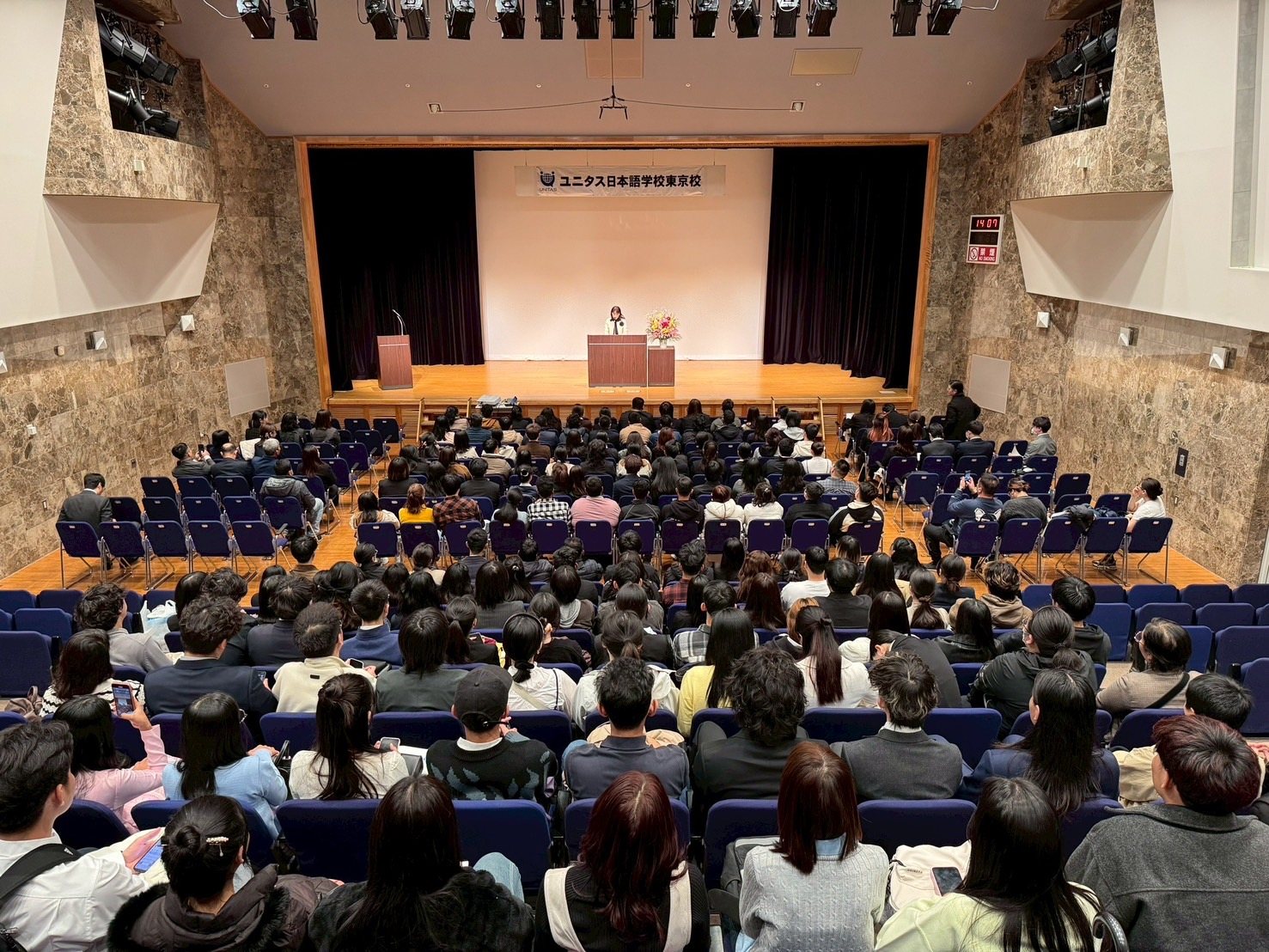
School life
For 1 year
- 1
- The January intake entrance ceremony was held.
- 3
- Graduation ceremony
- 4
- Apr intake entrance ceremony
- 7
- Jul intake entrance ceremony
- 10
- The entrance ceremony for the October 2026 term was held. · October 26: A health checkup was held
- 12
- School trip (2025)
The Tokyo campus holds Japanese culture experience classes only for a few months before the March end of term, not year-round
- Each term, extracurricular activities include calligraphy and flower arrangement, as well as visits to cultural-experience facilities in Tokyo.
- School trip on Dec 12, 2025. Students choose the destination: Seibuen Amusement Park or Hakone.
- Day trips: a barbecue (Apr 2024), Disneyland (Sep 2023), and Yokohama Hakkeijima Sea Paradise and an outlet mall (Dec 2022).
- Disaster drills every term
- The school works with a nearby library and a football team in Shinjuku-ku to encourage exchange with Japanese people and participation in sports events.
- Joins local festivals and city-run events
On campus
- Building 3
- Large self-study space — Building 3 opened in October 2023. Shinjuku's skyscrapers are visible from the classrooms, and there is a large self-study space
- Building 3, 5th floor
- Spacious area — In 2024 the school newly rented a large space on the 5th floor of Building No. 3, planned for classrooms and self-study space.
- On campus
- Lounge and self-study space — Students can make good use of their time outside class too.
- On campus
- Wi-Fi
2025–2026 academic calendar · Older data
- Saturdays, Sundays and public holidays
- Every week and public holidays · Monday to Friday (except public holidays and school-designated breaks)
- Winter break
- 2025-12-27 ~ 2026-01-04
- Summer break
- 2024-08-10 ~ 2024-08-18 · Unitas Japanese Language School is closed for summer from Aug 10 to Aug 18, 2024.
- Golden Week closure
- 2023-05-03 ~ 2023-05-07 · Closure: May 3–7, 2023
School website · 2026-02-06 updated
Access
- Transit
- Fukutoshin Line, Toei Oedo Line Higashi-Shinjuku Station, 5 min walk
Nishi-Waseda Station, 7 min walk
JR Yamanote Line, Shin-Okubo Station, 10 min walk
Okubo Station, 15 min walk - Nearby
- Located in Shinjuku-ku and accessible from 4 stations. Waseda University, other universities, high schools and parks are nearby, giving the area a calm student-town atmosphere.
- Dormitory
- None · SALLAE helps you look for housing nearby · Per the school website
School website · 2025-03-14 updated
Student dormitory — The school has no dormitory but introduces share houses and apartments to students who want one. Tokyo reference rents: share house ¥40,000–80,000/month (10–30 min by foot plus train or bus); apartment ¥50,000–100,000/month (up to 2 people). Move-in costs, insurance and other fees are separate, and some places require 3–6 months' rent paid in advance.
School website · 2025-03-14 updated
SALLAE has organized the school website and published data in English.
The update date is the day that material was last revised.
Photos are materials published by the school.
This information is compiled from official sources and is not updated daily. Please confirm with the official contact before signing or applying.