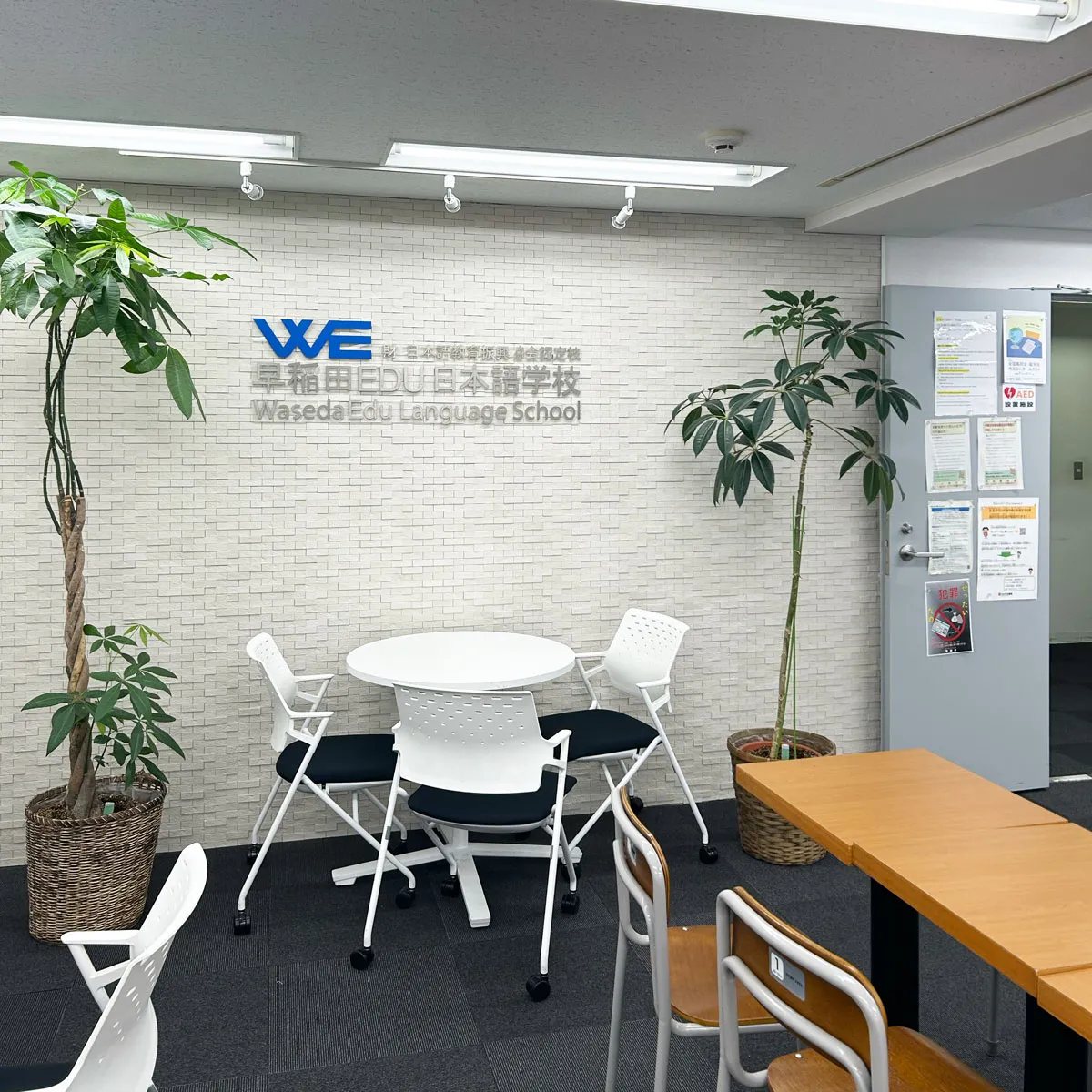
Waseda EDU Japanese Language School
Waseda EDU Japanese Language School
- Course
- Further-study course only ›
- Tuition
- On the cheaper side for Tokyo ›
- Admission
- 4 times a year · choose your intake month ›
Compare side by side with other schools →
Tuition and conditions may change depending on the intake. If you contact us, we will check with the school and give you accurate details.
Nearby schools comparedBy distance · no ads or paid placement
- Waseda EDU Japanese Language SchoolThis schoolTuition/yr¥759,000Progression—IntakesJan · Apr · Jul · Oct
- Tokyo Language Academy0.4km›Tuition/yr¥795,000Progression78%IntakesApr · Jul · Oct
- Academy of Language Arts1km›Tuition/yr—Progression42%IntakesJan · Apr · Jul · Oct
- Nichibei Conversation Institute Japanese Language Training Center1.1km›Tuition/yr¥991,000Progression—IntakesJan · Apr · Jul · Oct
— means SALLAE has not yet found the data.
About the school
All 4 courses in the school regulations (2 years, 1 year 9 months, 1 year 6 months, 1 year 3 months) are progression courses, making this a progression-focused school. Among the 295 FY2025 graduates, there were acceptances at 49 graduate schools, 151 universities and 125 vocational schools (including multiple acceptances by one student), and from the intermediate level there are graduate school and EJU elective classes and free individual graduate school guidance. Since 2014 it has offered guidance for progression to art universities and graduate schools (a paid art classroom), and its cumulative acceptances include Tokyo University of the Arts, Musashino Art University and Tama Art University. In Ichigaya, Shinjuku-ku, Tokyo, 4 minutes on foot from Tokyo Metro Ichigaya Station, it is a school with a capacity of 960, and of the 867 students enrolled in 2025, 636 are from China.
Published data and school website
Tuition
If you saw a lower amount elsewhere, it may not include the admission fee and application fee
Median 1-year tuition in other areas — Kyoto ¥911,000(7 schools) · Kanagawa ¥880,000(8 schools) · Okinawa ¥858,000(6 schools) · Tokyo ¥840,600(56 schools) · Fukuoka ¥835,000(12 schools) · Hyogo ¥825,500(7 schools) · Osaka ¥814,000(27 schools) · Shizuoka ¥790,000(9 schools) · Chiba ¥745,333(10 schools) · Aichi ¥740,667(5 schools)
Total by intake
| Intake · length | Full course |
|---|---|
| 1 year 3 months | ¥932,000 |
| 1 year 6 months | ¥1,105,000 |
| 1 year 9 months | ¥1,278,000 |
| 2 years | ¥1,450,000 |
Cost details · Course tables · Notes
- Per term
- ¥172,667 3 months
- One-time fees
- ¥68,665Application fee · Admission fee
| Duration | Total |
|---|---|
| 1 year 3 months | ¥932,000 |
| 1 year 6 months | ¥1,104,667 |
| 1 year 9 months | ¥1,277,334 |
| 2 years | ¥1,450,001 |
★"Per term" and "One-time at start" were calculated by SALLAE from each course's total. The courses this school actually offers are 1 year 3 months onward — all amounts in the table are values calculated by SALLAE.
Calculated by SALLAE · verified 2026-09-16
Admission & dates
- Apr intake
- 2-year course · Application September–October of the previous year
- Jul intake
- 1 year 9 months course · Application January–February of the same year
- Oct intake
- 1 year 6 months course · Application March–April of the same year
- Jan intake
- 1 year 3 months course · Application July–August of the previous year
Deadline and capacity rules
All intakes close as soon as capacity is reached / January intake may not be recruited / Application periods may change without notice
School website · Updated 2026-05-22
Classes
- Morning
- 09:30-12:45 Morning class: 9:30–12:45 (with a break) / Afternoon class: 13:30–16:45 / 4 periods of 45 minutes
- Afternoon
- 13:30-16:45 Morning class: 9:30–12:45 (with a break) / Afternoon class: 13:30–16:45 / 4 periods of 45 minutes
- AM/PM placement
- Moving between the morning and afternoon classes is possible only once during enrollment, if you have an attendance rate of 95%, excellent grades and a vacancy in the destination class. Tell your homeroom teacher during the term (school regulation details).
- Class size
- Max 20 students
- Elective classes
- Graduate school · EJU · From Intermediate (N2 level), graduate school and EJU elective classes twice a week / Graduate school guidance is for students who are university graduates with Japanese ability of N2 or higher / "Preparation course" and "Practice course"
Materials · Subjects · Timetable · Details
- Materials
- Main textbook for Beginner and Pre-intermediate: "Dekiru Nihongo" / main textbooks for Intermediate and Advanced and graduate-school prep textbooks (elective classes) are original Waseda EDU texts
A: 100%–80%, B: 79%–70%, C: 69%–60%, D: 59% or below / The year is divided into 4 terms (Apr 1–Jun 30, etc.)
School website · Updated 2026-05-22
Documents
- Application form, résumé, statement of reasonsSchool-designated form
- Diploma and transcript of the final school attended
- Certificate of Japanese study150 hours or more
- Japanese level test score certificateJ-TEST/JLPT
- Notarized certificate of family relationshipRelationship between the applicant and the financial sponsor
- Passport and copy of the household register
- 5 photosFront view, 3×4
Sponsor documents · Only if applicable
Submitted by the person paying the tuition (financial sponsor)
- Financial sponsorship statementSchool-designated form
- Balance certificateFixed-term deposit equivalent to ¥3,000,000
- Employment certificate of the financial sponsorCopy of business license if self-employed
- Income certificate of the financial sponsorStating income for the past 3 years
- Copy of family register
- Residence certificate (jūminhyō)Listing all family members
- Tax payment certificatePast 3 years
Only if applicable
- Education verification (for university or vocational school graduates)
For university or vocational school graduates, academic credential verification; for high school graduates, gaokao or huikao verification. SALLAE is confirming this with the school.
School website · Updated 2026-05-22
Admission process
- Request an admission consultation — School tours and individual explanations can be requested through the inquiry form
- Prepare application documents and mail them to the school — From 6 months before enrollment, applicants contact the local agency and mail their materials to the school before the application deadline.
- Application for the Certificate of Eligibility — 3 months before enrollment, the school organizes the application materials and applies to the Immigration Bureau.
- Review by the Immigration Services Agency — It takes about 2.5 months from submitting the application documents to the Immigration Bureau until the Certificate of Eligibility is issued.
- Results notice — 1 month before enrollment, the Immigration Bureau announces the screening result, and the school notifies the student.
- Tuition — Transfer tuition to the school's account. After confirming payment, the school mails the original Certificate of Eligibility to the student.
- Visa application — After receiving the Certificate of Eligibility, the student applies for a visa at the local embassy.
- Arrive in Japan and start life there — Arrive in Japan before classes begin and start life in Japan.
- Placement test
- Before classes begin, the school assesses each student's Japanese ability through tests and other means and organizes classes appropriately.
School website · Updated 2026-05-22
Short-term study
- Open now?
- Rolling admissions, so availability varies from time to time — SALLAE will confirm with the school
Course without a student visa
- Waseda EDU Art Academy — Basic art guidance (basic course guidance, portfolio organization, interview and essay guidance) / Art graduate school progression course 36 hours / Individual guidance course 72 hours
- Waseda EDU Bunri Academy — Waseda EDU Bunri Academy (EJU prep class for Chinese students): EJU Japanese, English, humanities mathematics, humanities comprehensive, science mathematics, science comprehensive
★Short-term courses are not listed in the published data — it counts only student-visa courses.
School website · 2026-08-28 updated
Progression
| FY2025 | Admitted |
|---|---|
| Graduate school | 49 students |
| University | 151 students |
| Vocational school | 125 students |
| Graduates | 295 students |
All schools accepted to so far
See 5 more schools
+3 more schools
FY2025: graduate school 49, university 151, vocational school 125 / includes the count of 1 student who passed multiple schools / excludes those with job offers and those who returned home · School website · Updated 2026-05-22
Reviews
If you study here or used to, tell others what the classes, teachers and daily life were like. It helps anyone deciding on this school.
Write the first reviewUniversity prep
- Homeroom teacher — Homeroom teachers give careful guidance suited to each student's path and personality, including interview manners, preparation of application documents and interview practice.
- Progression materials — Materials on universities, graduate schools and vocational schools are available. Students can freely get information through the progression portal (on-campus website).
- On-campus briefing — Admissions staff from universities, graduate schools and vocational schools are invited to the school to hold information sessions / Examples: Ritsumeikan University, Aoyama Gakuin University, Kyoto University of the Arts
- Many designated-school recommendation slots — There are many designated-school recommendations, at well-known universities, vocational schools and others, available if you meet the conditions. Details are posted on the on-campus bulletin board.
- Graduate school and EJU elective classes — From Intermediate (N2 level), twice a week
- Individual graduate school guidance — Regardless of the intake month or class level, students who have prepared a research plan and similar documents can receive free guidance from an instructor specializing in graduate school entrance exams.
- Rules on excused absences — If attendance is required at the school or employer you are going to, such as for orientations or class placement tests, the absence is excused (treated the same as attendance)
School website · Updated 2026-05-22
Daily-life support
- Native-language consultation — Consult your homeroom teacher about studies and the office staff about daily life
- Orientation — An orientation on life as an international student is held right after enrollment, and also for all enrolled students.
- Health checkup — Health checkup once a year
- Insurance — All eligible students are enrolled in National Health Insurance as well as international student insurance / 70% of covered medical costs are paid by insurance
- Disaster drill — The school has set evacuation methods, routes and places for disasters such as fires, earthquakes and typhoons, and holds evacuation drills.
- Commuter pass — Only the Tokyo Metropolitan Bureau of Transportation (Toei Subway, etc.) sells commuter passes for students. JR and Tokyo Metro do not
- Part-time work — On a student visa, you can work part-time up to 28 hours a week once you obtain permission to engage in activity other than that permitted by your status of residence from the Immigration Bureau.
School website · Updated 2026-05-22
Scholarship
- MEXT learning incentive for international students
- Monthly ¥30,000 × 1 yearStudents with excellent attendance and grades who need living support are recommended, and after review by the Japan Student Services Organization (JASSO), a scholarship of ¥30,000 a month is paid for 12 months.
- Academic excellence scholarship
- ¥10,000 OnceFrom among graduates, students with excellent grades, class attitude and attendance are selected and each receives a ¥10,000 award.
- Annual perfect attendance award
- ¥10,000 Once Students with no absences for a whole year receive ¥10,000 as a perfect attendance award.
- Perfect attendance award at course completion
- With 100% attendance until the end of the course, cash at graduation: 2-year course ¥22,000 / 1 year 9 months ¥19,000 / 1 year 6 months ¥16,000 / 1 year 3 months ¥13,000
School website · 2026-08-28 updated
Students
Enrolled 867 (2025) · Capacity 960 National median: 180 students
Based on 867 students enrolled in 2025.
Public data from the Association for the Promotion of Japanese Language Education (Nisshinkyo) · verified 2026-09-20
School life
For 1 year
- 4
- The April 2026 entrance ceremony was held on Friday, April 3, at Ushigome Tansu Ward Hall.
- 5
- Extracurricular lesson at Yomiuriland (May 29, 2026) / Seibuen Amusement Park, May 30, 2025
- 10
- At the end of October, students and teachers dress up in costumes and enjoy games with prizes inside the school. In FY2025 there was a costume contest.
- 11
- Japanese traditional instruments appreciation session, Nov 18, 2025 / Wadaiko drum appreciation session, Nov 6, 2024
- 2
- Speech contest
- 3
- Students with 100% attendance until the end of the course receive cash as a perfect attendance award at graduation
The place and content change every year · Event costs are included in tuition; there is no separate payment.
- A major school-wide event held at the end of the school year. Judges are invited from the higher education institutions students progress to, and students serve as emcees.
- Yokohama Hakkeijima Sea Paradise, Jun 21, 2024 / Fuji-Q Highland, Jun 23, 2023
- Rakugo appreciation session, Dec 11, 2023 / Wadaiko drum appreciation session, Nov 6, 2024 / Japanese traditional instruments appreciation session, Nov 18, 2025
- Collaborative class "Learning Japanese through Manzai" with Furanpone and Yumi Fujita
- Exchange with Ushigome Nakano Elementary School / futsal exchange with Criacao Shinjuku
- The school offers Japanese culture experiences such as painting uchiwa fans, and trial classes of vocational schools.
Clubs
- Student public relations committee — Students take the lead in making videos. The videos are published on the school's YouTube channel.
- LINC Japanese Club
On campus
- TK Daiichi Building, 2nd–5th floors
- (Main school) — 2-7 Ichigaya-Sagoharacho, Shinjuku-ku, Tokyo
- 1st floor of a separate building (Tanaka Hozen Building)
- (Branch school) — 2-7-19 Ichigaya-Sagoharacho, Shinjuku-ku, Tokyo
- On campus
- Self-study room — Rooms are set aside where students can study on their own outside class hours
- On campus
- Art classroom — Waseda EDU Art Academy: basic art guidance is given in the school's art classroom 6 times a week (self-study from 13:30 every day, and 18:00–21:00)
2026–2027 academic calendar
- Saturdays and Sundays
- Weekly
- Days stipulated by the Act on National Holidays
- Public holidays set by law
- Term break
- Every term (the period is not stated on the website)
- Golden Week closure
- Closed Apr 29–May 6, 2026. Normal operations resume May 7.
School website · Updated 2026-05-25
Access
- Transit
- Tokyo Metro Namboku Line Ichigaya Station, 4 min walk Exit 5
Tokyo Metro Yurakucho Line Ichigaya Station, 4 min walk Exit 5
JR Ichigaya Station (Ichigaya Station), 8 min walk Exit 1
Toei Subway Shinjuku Line, Ichigaya Station, 8 min walk Exit 1
Toei Oedo Line Ushigome-kagurazaka Station on foot 10 min Exit A1
Tokyo Metro Tozai Line, Kagurazaka Station, 12 min walk Exit 2 - Nearby
- The Ichigaya area is a student town with many universities and vocational schools, including Hosei University and Nihon University / It has excellent access to major Tokyo areas such as Shinjuku, Ikebukuro and Tokyo Station.
- Dormitory
- Available · The school introduces dormitories it has partnered with. Please inquire separately for details. · Based on school website
School website · 2026-08-28 updated
Dormitory — Housing support is provided.
School website · Updated 2026-05-22
SALLAE has organized the school website and published data in English.
The update date is the day that material was last revised.
Photos are materials published by the school.
This information is compiled from official sources and is not updated daily. Please confirm with the official contact before signing or applying.